
Intro disclaimer
This page provides a general overview of published research on vibro-acoustic stimulation and low-frequency vibration. It does not represent claims about the specific effects of the LifePod. Individual studies vary in sample size, design, and strength of evidence.
Frontiers in Sports and Active Living (2025)
Low-frequency vibration increased parasympathetic activity (vagal tone) 30 minutes post-session in active male participants

Acute Whole-Body Vibration & Brain Excitability
Relationship between vibration frequency (5–35 Hz) and HRV/brain excitability
Whole-Body Vibration & Cognitive Speed (2025)
Acute effects on cognitive speed in young adults
Scoping review (430 records screened, 20 included)
Overview of vibro-acoustic therapy for chronic pain; explicitly notes more RCTs are needed
Iaccarino et al., Nature 2016
Foundational study on 40 Hz gamma entrainment (animal model)
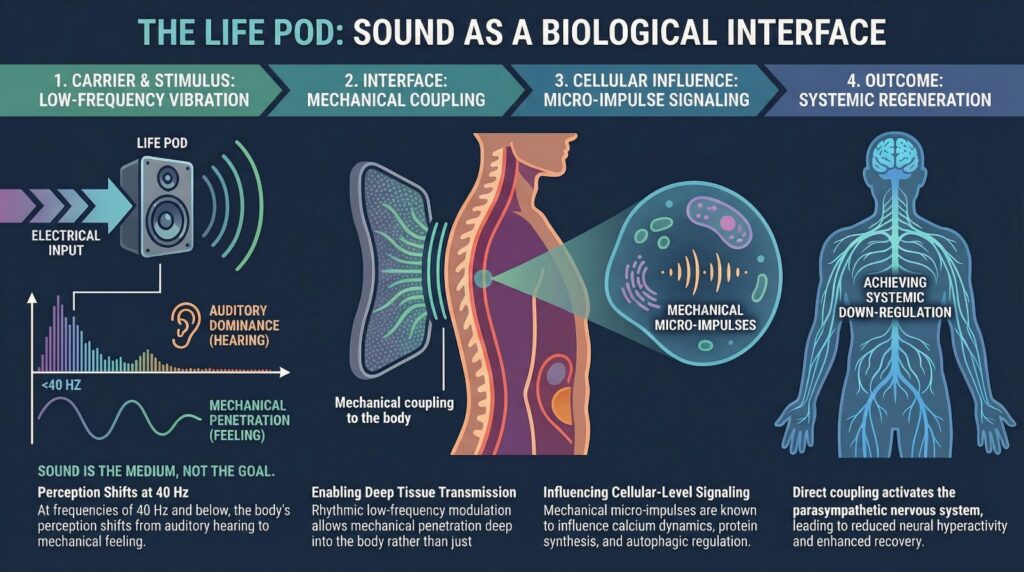
Process Breakdown
- Carrier & Stimulus (The Transition of Perception): The model identifies a threshold at 40 Hz, where human perception transitions from auditory processing to somatic mechanoreception. By focusing on frequencies <40 Hz, the system leverages mechanical penetration to bypass conventional hearing, using the body as the primary interface for input.
- Interface (Mechanical Coupling): The efficiency of this approach relies on precise mechanical coupling between the transducer and the user. The goal is to move beyond superficial stimulation to achieve deep tissue transmission, ensuring the vibration propagates through the body’s structure to support recovery.
- Cellular Influence (Mechanotransduction): The hypothesis suggests that these mechanical micro-impulses may influence cellular signaling pathways. Specifically, by potentially impacting calcium dynamics and protein synthesis, this mechanism acts as a form of mechanotransduction, where physical energy is utilized to promote cellular-level engagement.
- Outcome (Systemic Recovery): The objective is to support the activation of the parasympathetic nervous system. By promoting a shift toward systemic down-regulation, the LifePod is designed to counteract neural hyperactivity—a state often associated with fatigue—thereby facilitating enhanced recovery and homeostasis.